Why I Added Red Light Therapy to My Practice — And What It's Done for My Own Body
I'm a massage therapist and lymphatic drainage specialist. Every day I work with people carrying chronic pain — in their joints, their fascia, their deep connective tissue. I know how exhausting it is. I also know that what happens between sessions matters just as much as the treatment itself.
So when I started looking seriously at red light therapy, I wasn't just researching it for my clients. I use it on myself. And as someone managing joint pain personally, I can tell you — I've felt the difference.
Personal note: I use the Pro Panel Max on my own joints and have experienced real, noticeable relief. That's not something I say lightly as a clinician and it's why I have introduced red light to the clinic.
What is red light therapy?
Red and near-infrared light at specific wavelengths penetrates your skin and stimulates cellular repair. It's not fringe wellness — it's called photobiomodulation, and it's backed by decades of clinical research. The mechanism is straightforward:
Light energy is absorbed by your cells
This stimulates mitochondrial activity — your cells' energy production
Cellular repair accelerates, inflammation reduces, circulation improves
Why this panel — and what makes 1060nm special
Most red light panels use one or two wavelengths, typically in the 630–850nm range. That's useful for surface skin repair. But for chronic pain, deep joints, and connective tissue conditions? You need to go deeper.
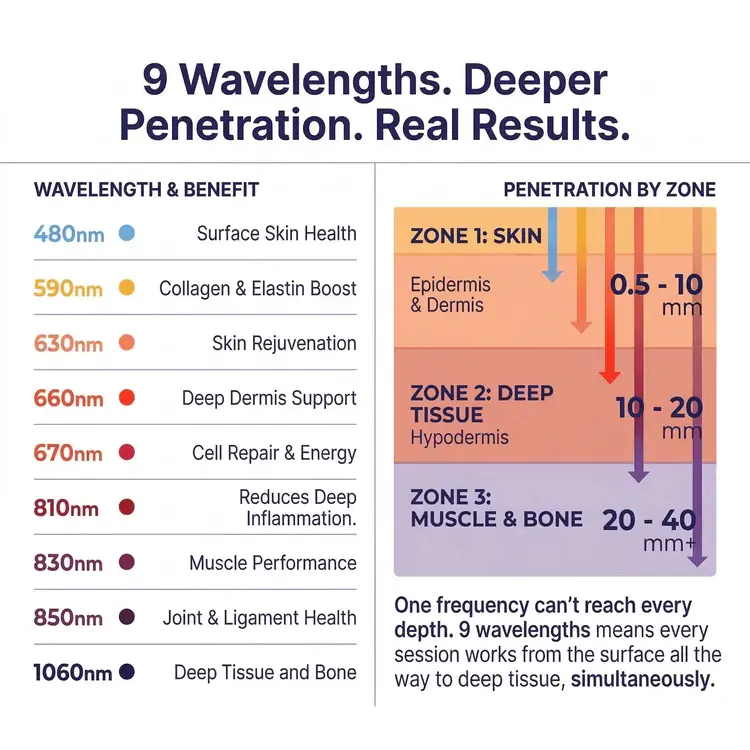
The Pro Panel Max runs 9 therapeutic wavelengths simultaneously, including 1060nm near-infrared — a wavelength that is rarely included even in high-end devices.
It's also not a gimmick - TGA, FDA, CE and FCC certified
Near-zero EMF · Irradiance 210 mW/cm² at 7cm · 170 mW/cm² at 15cm
Why 1060nm matters
Standard NIR tops out at 810–850nm — fine for muscle, shallow tissue
1060nm penetrates into tendons, fascia, and bone
Especially beneficial for chronic joint conditions and deep-tissue recovery
Every session treats every layer at once — skin surface all the way to deep tissue
Who is this for?
In my clinical experience, the people who benefit most are those managing:
Chronic joint pain — rheumatoid arthritis, osteoarthritis, hands, knees, hips
Chronic lower back pain — ongoing inflammation and mobility limitations
Lipoedema — reducing systemic inflammation is a key part of lipoedema management, and near-infrared light supports this directly by calming inflammatory pathways in affected tissue
Post-surgical recovery — supporting tissue repair and reducing swelling
Muscle soreness and slow recovery — especially for those who stay active despite pain
Skin health — collagen stimulation as a welcome side effect
What the research says
This isn't anecdotal. Red light therapy is supported by peer-reviewed research including:
Reduced pain and inflammation in rheumatoid arthritis
Significantly improved joint function in osteoarthritis
Reduced chronic lower back pain and improved mobility
Faster muscle soreness recovery following intense physical activity
Improved collagen density and reduction in fine lines
How to use it
Session length: 10–20 minutes per area
Frequency: 4–5 times per week (daily use is safe)
Distance: Approximately 15cm for full therapeutic output
Results: Most people notice a real shift within 2–4 weeks of consistent use
I don't recommend things I don't believe in. Red light therapy isn't a miracle — nothing is. But as someone who treats chronic pain every day, having an evidence-based, drug-free tool you can use at home every single day is genuinely valuable.
Twenty minutes. No pills. No side effects. Your cells doing what they already know how to do — just with a little more support.
Not recommended for: pregnant women, people with epilepsy, photosensitive skin conditions, or electronic medical implants such as pacemakers.
Please consult your GP if you have an active medical condition before making an appointment.


Comments